

National Conciliation Service Scheme Rules - under the Digital Markets, Competition and Consumers (DMCC) Act 2024.
National Conciliation Service is accredited by CTSI under delegated powers from the Secretary of State for Business and Trade, under the Digital Markets, Competition and Consumers Act 2024.
Contents
Referring a complaint to National Conciliation Service. 3
Vulnerable Consumers Policy. 6
About us
National Conciliation Service (NCS) provides Alternative Dispute Resolution (ADR) for complaints brought by a consumer against a trader, who is a member of National Conciliation Service
To find out if a trader you have a complaint about is a member, please click here https://www.nationalconciliationservice.co.uk/file-a-complaint/
The National Conciliation Service ADR process is free to consumers and Independent reports are not deemed essential for the ADR process.
Fees are applicable to traders who subscribe to the National Conciliation Service. Further information on applicable trader fees can be provided by the NCS on request.National Conciliation Service’s annual report can be viewed here https://www.nationalconciliationservice.co.uk/about-us/who-we-are/
Scope of the ADR process
National Conciliation Service’ uses conciliation to resolve complaints.
We offer ADR for complaints relating to automotive retail complaints between UK and NCS subscribers.
Participation in National Conciliation Service ADR process may result in the following possible outcomes:
- A mutually agreed settlement between the consumer and the business.
- An agreement for a refund, whether full or partial.
- An agreement for repair or rectification work to be carried out.
- An agreement for replacement goods or services.
- An agreement regarding reimbursement of costs.
- An agreement concerning the return or retention of a deposit.
- An agreement for other practical remedies acceptable to both parties.
- Resolution of some issues while leaving others unresolved.
- No agreement reached, resulting in closure of the conciliation process without settlement.
The conciliator does not impose a decision on the parties. The role of the conciliator is to facilitate communication, assist the parties in understanding each other's position, and help them reach a voluntary and mutually acceptable resolution.
The National Conciliation Service is an independent, non-profit making organisation and a company limited by guarantee. The NCS provides a free-to-consumer ADR service for disputes arising between UK residents and businesses that subscribe to the NCS scheme.
The NCS's current team of case handlers has more than 30 years' experience in resolving disputes between consumers and businesses operating within the motor trade.
Types of complaints
The NCS is competent to deal with disputes relating to the motor industry, including but not limited to:
- Sale contracts for new and used motor vehicles.
- Service, maintenance and repair contracts for motor vehicles.
- Complaints relating to used vehicles.
- Disputes concerning deposits, including lost or withheld deposits.
- Complaints regarding the quality of goods or services supplied by participating businesses.
- Disputes concerning contractual obligations between consumers and participating businesses.
General information
- National Conciliation Service can only accept complaints in English, and the ADR procedure will be conducted in English.
- The ADR procedure will be conducted in writing.
- We will take into account the below legislation when resolving complaints:
- The Digital Markets, Competition and Consumers Act (2024) - Outlines requirements and enforcement powers in relation to digital markets, consumer rights and competition law.
- The Alternative Dispute Resolution for Consumer Disputes (Competent Authorities and Information) Regulations 2015 - States that businesses must inform customer about certified ADR providers if a compliant cannot be resolved internally.
- Sector-specific legislation including Motor Vehicle Block Exemption Order (MVBEO) and Vehicle Type Approval (Regulation EU 2018/858)
- The complainant can withdraw their complaint from this ADR procedure at any time.
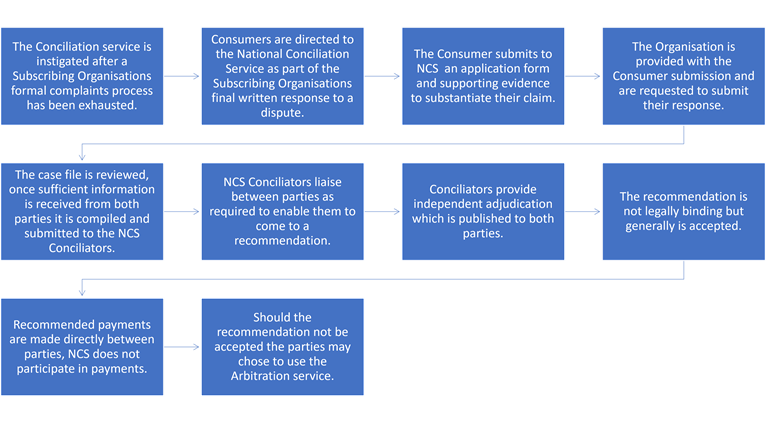
- Any outcome of the ADR procedure is not legally binding and does not prevent a consumer seeking redress through the courts.
- Both parties are entitled to be represented or assisted by another person.
- The average length of the ADR process is currently 72 days.
Referring a complaint to National Conciliation Service
- National Conciliation Service members should inform customers that they have access to a free ADR service thorough National Conciliation Service, when they have reached the end of their internal complaints process. Details on how to contact National Conciliation Service should be provided to customers by the member.
- The complainant must have exhausted the business members complaints process, before a complaint can be raised with National Conciliation Service.
- Complainants have 12 months from the date of the business members final response to raise a complaint with National Conciliation Service.
- Only complaints about National Conciliation Service members can use this service.
- Complaints can be submitted using the contact details outlined above, or by submitting through the online portal, here. https://www.nationalconciliationservice.co.uk/file-a-complaint/
Grounds for Refusal
National Conciliation Service may refuse to handle your complaint due to one or more of the following reasons:
- Prior to submitting the complaint to National Conciliation Service the complainant has not attempted to contact the trader concerned to discuss the complaint and sought, as a first step, to resolve the matter directly with the trader.
- The dispute is frivolous or vexatious.
- The dispute is being, or has been previously, considered by another ADR entity or by a court.
- The value of the claim falls below the amount of £50.
- The complainant has not submitted the complaint within the time frames mentioned above.
- Dealing with such a type of dispute would seriously impair the effective operation of National Conciliation Service
- Either party has deliberately sought to mislead the National Conciliation Service on a matter relating to the existence or non-existence of any grounds for refusing to deal with the dispute, the NCS reserves the right to immediately refuse to accept or to discontinue dealing with the complaint at any stage, even if any applicable deadline has already passed.
- The trader is not a subscriber to the National Conciliation Service (NCS).
- The complaint relates to regulated financial services or financial products which fall outside the remit of the National Conciliation Service.
If the NCS cannot handle your complaint due to one or more of the above, both parties will be notified within 10 working days.
ADR Procedure
- Once National Conciliation Service has received the complaint from the complainant, we will review it to ensure it is something we can handle. If it is not possible for us to handle your complaint, we will let you know as soon as possible and, where possible, you will be signposted to other organisation(s) who may be able to help.
- If the complaint can be handled, National Conciliation Service will acknowledge this to both parties and provide details on the ADR procedure, including expected timeframes.
- If there is a conflict of interest, National Conciliation Service policy on this will be followed (see below).
- All relevant information will be collated by National Conciliation Service from both parties, who will have a reasonable amount of time to express their points of view.
- The information required can be submitted either online or by post and may include, but is not limited to:
- Copies of invoices, estimates, independent reports, evidenced of incurred costs.
- Once all required information is received from the complainant, this will be provided to the business for comment. The business will have 10 working days to respond.
- Once the information has been provided by the business, this evidence will be sent to the complainant for final comment. The complainant will have 10 working days to respond.
- Once National Conciliation Service has all the required information for the ADR process to begin, and both parties have had opportunity to consider the arguments and evidence put forward by the other party, this will be considered the ‘complete case file’ and both parties will be notified in writing at this point.
- Once National Conciliation Service is in receipt of the complete case file, the outcome will be notified to both parties in writing within 90 days.
- National Conciliation Service will keep parties to the dispute informed about the conduct and progress of any ADR being carried out in writing.
- The complainant can withdraw their complaint from this ADR procedure at any time.
- Once the ADR procedure has concluded and a decision reached, both parties will be provided with this in writing and we will explain how the outcome has been reached.
- We do not impose decisions on consumers. Our ADR process is voluntary and based on the agreement of the parties involved.
- Parties are given a reasonable period to review and reflect on any proposed resolution before deciding whether to accept it. Any outcome is only implemented with the parties’ agreement, and consumers retain their full statutory rights throughout the process.
- At this point we will also remind parties of the following:
- Participation in the procedure does not prevent the possibility of seeking redress through court proceedings.
- The proposed solution may be different from an outcome determined by a court applying legal rules.
Contact details
National Conciliation Service
Santis House
Curriers Close
Coventry
CV4 8AW
Email: contact@nationalconciliationservice.co.uk
Conflict of interest
A case handler is under an obligation to disclose to the NCS any circumstance/s that may affect their independence and impartiality, or that may be seen to affect their independence and impartiality or give rise to a conflict of interests with either party involved in the dispute – either business or consumer.
The obligation to disclose any conflict of interest is present throughout the entirety of the case procedure.
Where a case handler has declared a conflict of interest and/or a concern regarding their independence or impartiality:
- NCS will replace the case handler; or (failing that)
- NCS will offer the parties the opportunity to transfer the dispute to another NCS case handler who can deal with the dispute; or (failing that)
iii. NCS will disclose the circumstances to the parties, and if both parties agree to it (having been told of their right to object), the case handler will continue to handle the dispute and oversee the ADR procedure.
In the unlikely event that NCS has only one case handler, the obligation for the case handler to disclose any conflicts of interest/concerns about independence and impartiality to the NCS does not apply. But the NCS may offer both parties the right to transfer the dispute to another ADR provider, which can deal with the dispute; or (failing that) NCS will disclose the circumstances to the parties, and if both parties agree to it (having been told of their right to object), the case handler will continue to handle the dispute and oversee the ADR procedure.
Vulnerable Consumers Policy
A vulnerable customer is someone who, due to their personal circumstances, is especially susceptible to harm - particularly when an organisation is not acting with appropriate levels of care.
All customers are at risk of becoming vulnerable, but this risk is increased by having characteristics of vulnerability. These could be poor health, such as cognitive impairment, life events such as new caring responsibilities, low resilience to cope with financial or emotional shocks and low capability, such as poor literacy or numeracy skills.
Actions we will take to treat vulnerable customers fairly
Understanding the needs of vulnerable customers
- We will understand the nature and scale of characteristics of vulnerability that exist in the individuals who approach us with ADR requirements.
- We will understand the impact of vulnerability on the needs of our customers, by asking what types of harm or disadvantage they may be vulnerable to, and how this might affect the consumer ADR experience and outcomes.
Skills and capability of staff
- We will embed the fair treatment of vulnerable consumers across the workforce. All ADR staff will be trained in how their role affects the fair treatment of vulnerable consumers.
- We will ensure frontline staff have the necessary skills and capability to recognise and respond to a range of characteristics of vulnerability.
- We will offer practical and emotional support to frontline staff dealing with vulnerable consumers.
Taking practical action
Product and service design:
- We will consider the potential positive and negative impacts of all ADR services on vulnerable consumers. We will design current and future services to avoid potential harmful impacts.
- We will take vulnerable consumers into account at all stages of the service design process, including idea generation, development, testing, launch and review, to make sure products and services meet their needs.
Customer service:
- We will set up and operate all systems and processes in a way that will support and enable vulnerable consumers to disclose their needs. Staff will be trained to spot signs of vulnerability.
- We will deliver appropriate customer service that responds flexibly to the needs of vulnerable consumers.
- We will make consumers aware of support available to them, including relevant options for third party representation and specialist support services.
- We will put in place systems and processes that support the delivery of good customer service, including systems to note and retrieve information about a customer’s needs.
Communications:
- We will make sure all communications and information about ADR services are understandable for consumers in their target market and customer base.
- We will consider how we communicate with vulnerable consumers, taking into consideration their needs. Where possible, we will offer multiple channels so vulnerable consumers have a choice.
Monitoring and evaluation
- We will implement appropriate processes to evaluate where we have not met the needs of vulnerable consumers, so that we can make improvements.
- We will produce and regularly review management information, appropriate to the nature of their business, on the outcomes we are delivering for vulnerable consumers.

.png)

-over.png)